Thursday, August 27, 2009

Who is George Matsumoto and what does he have to do with Kansas City?

Name: Matsumoto Residence
Architect: George Matsumoto
Year Designed: circa 1951
Builder: Frank Walser
Year Completed: 1952
Size: Unknown sq. ft. (3 bedroom, 1 bath)
Location: 821 Runnymede Road, Raleigh, North Carolina
Type: Residential
Style: Modern / International Style
Status: Good
Photographer: Joseph W. Molitor

George Matsumoto was a partner with David B. Runnells in Kansas City for one year at the firm Runnells Clark Waugh and Matsumoto Architects. We know that the firm did at least one house and the first new building then called just, "The Art School," for the Kansas City Art Institute, There may have been a Doctors Office done as well. It is unknown if the Doctors Office is still standing and if it was done by all four partners or with Matsumoto alone. Waugh and Matsumoto left the partnership to teach at University of Oklahoma with Henry Kamphoefner. They immediately left Oklahoma to start the new school of design at North Carolina State University in 1948.

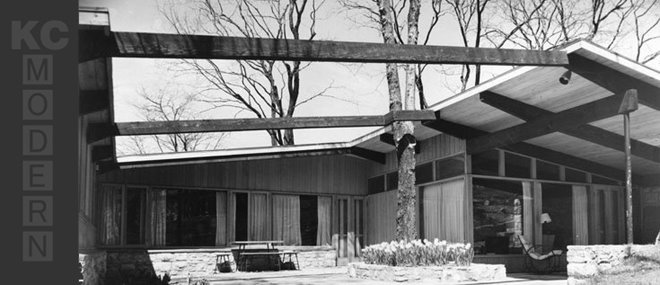
The photo above is the house that Matsumoto designed for himself in Raleigh, North Carolina. He won many awards for this design and went on to complete many residential commissions.

The folks over at Triangle Modernist Houses have also done a great job of documenting the career of George Matsumoto in North Carolina. The Matsumoto Tribute from and exhibit they did over at the North Carolina State Library has some good info too. Here is the George Matsumoto Group Pool on Flickr.

Below is and excerpt from from the National Park Service Website about the Matsumoto House
The Matsumoto House is one of several Modernist houses built in Raleigh from the 1940s to the 1960s. These houses were the manifestation of architectural concepts embraced by the faculty of the School of Design, established in 1948 at North Carolina State College (now North Carolina State University). Dean Henry Kamphoefner recruited several Modernist architects as faculty members, and was instrumental in influencing other Modernists to come to North Carolina to practice. He also brought internationally known architects to the school to lecture and to lead studio workshops. The faculty designed several residences for themselves, other faculty members, or for a small group of clients interested in new ideas in architecture. Built for the most part on relatively ample, wooded suburban lots,located on what then were the outskirts of the city, a key element in most of the designs is a careful integration of the house with its site.

In 1952, faculty member George Matsumoto began construction of his own house on a steeply sloping tract adjacent to a small stream. Its design shows the same attention to economical, post-and-beam modular construction and careful detailing as is seen in his earlier Richter House design. However, the young Japanese American architect was also strongly influenced by the work of Mies Van der Rohe, and the Matsumoto House demonstrates a Miesian concern with exposed structure and a sense of suspension generated by the use of lightweight wall, floor and ceiling planes to articulate its internal space. The sloping site allowed Matsumoto to put a lower level built of concrete block under the house, a space which contained his studio and which forms a base for the frame box cantilevered above it. The rectangular, flat-roofed mass of the main living areas is reached by a small bridge rising from a Japanese-influenced outdoor court. While the street side of the house presents a mostly-blank facade divided into panels, all of the rooms along the back of the house open with glass doors and windows onto a cantilevered, screened rear porch, extending the living space visually into the wooded hillside beyond. The Matsumoto House is a designated Raleigh Historic Landmark.

The Matsumoto House is located at 821 Runnymede Rd. It is a private residence and is not open to the public.

Wednesday, August 26, 2009

James Ingraham Clark Residence by Runnells Clark Waugh and Matsumoto Architects - Architects House Themselves

The James Ingraham Clark Residence won a mention in the P/A (Progressive Architecture) Awards in 1947. Below is an excerpt, including captions, from a Progressive Architecture article in April, 1949, pp 66-69. This is one of a few buildings known to exist from the Runnells Clark Waugh and Matsumoto Architects partnership. The others are the Kansas City Art Institute Art School Building and a possible Doctors Office that may not exist anymore. The first two photos are by Gene Hook all others by Fred Gund.


This is the home of one of the architects – James Ingraham Clark. -- looking south down the slope

House: Leawood, Kansas
Runnells Clark Waugh & Matsumoto Architects

PROGRAM: Suburban residence for a growing family. Space provided under present bedroom wing for duplication of facilities on upper level.

SITE: Land at end of cul-de-sac street; one acre sloping toward the south; stone ledge under most of actual house site.

SOLUTION: Plan organized to turn its back to the street side and open out to the east and south. Design developed to have advantages of prefabrication although built on the side. Ledge proved both solid and flat; hence, prefabricated heating panels and foundations were laid directly on the stone; footings needed under bedroom portion only where rock ledge ran out. Plan worked out on a 4’-1/4” module – the 4’ to take standard sheets of plywood; the ¼” to allow a space between sheets, eliminating any fitting or butting at the joints. Dry construction throughout.

MATERIALS AND METHODS

CONSTRUCTION: Framing: wood. Walls: no footings; stone foundations on solid rock; native stone. Interior finishes: Douglas fir plywood; exterior: 5-ply waterproof plywood. Floors: wood sash: double-insulating glazing; glass block (bathroom only). Insulation: acoustical; cement-impregnated wood-fiberboard exposed on ceilings; thermal’ double-thick expansible blanket; flameproof cotton: glass-wool batts: blown-in wool type. Partitions: frame. Surfaced both sides with plywood. Doors: birch-surfaced hollow core; solid flush exterior doors.

EQUIPMENT: Heating: hot-water radiant panel, zoned for three areas; gas-fired boiler; automatic controls; attic fan. Kitchen: electric stove, refrigerator, dishwasher, garbage disposal unit, deep freeze, and exhaust fan. Special equipment: water softener.


front door - (looking south)

view from street (utility rooms, left, bedroom wing, right)


bedroom wing, additional bedrooms to be added later at lower level


view from east (living rooms left, outdoor living, right center, service right


living room and porch (right); glazed stairwell (left)


(first floor plan)


south window of living room and stair hall to bedroom wing

fireplace corner of living room with east porch beyond


master bedroom with cantilevered deck outside southeast window wall


wall between dining area and kitchen


same wall, opened up

Tuesday, August 25, 2009

James Ingraham Clark Residence by Runnells Clark Waugh and Matsumoto Architects

Name: James Ingraham Clark Residence
Architect: Runnells Clark Waugh and Matsumoto Architects
James Ingraham Clark, Project Designer
Year Designed: circa 1947-48
Builder: Don Drummond
Year Completed: circa 1948
Size: Unknown
Location: Leawood, Kansas
(Greater Kansas City Area)
Type: Residential
Style: Modern
Status: Good
Photographer: Gene Hook
Photos scanned from and article excerpted from: The American House Today : 85 Notable Examples Selected and Evaluated by Katherine Morrow Ford and Thomas H. Creighton, Reinhold, 1951, pp 134-135

KANSAS CITY, MISSOURI

Built for one of the partners in an architectural firm, this house of the James Ingraham Clarks is planned carefully for expansion as the family grows. It turns away from the street – originally a quite thoroughfare which has since became much more busy, partly because people come to see the house – and faces towards the south and southeast on a sloping site which ends in a wooded creek bed. When the house was built there was one child; now there are two, and family plans are for two more. Hence it was desired that the house could grow both in bedroom accommodations and in living space. Facing the street is a “core” which will not change: utility rooms, kitchens, laundry and garage. Past these rooms as one enters the house is a living room which is at present reasonably large, but certainly not oversized. In the future, as the plan indicates, this room will be extended, and even may have a porch on the end as a final expansion. The solution to the addition of bedrooms is made possible by a steep drop of fifteen feet in the site at the point where the bedroom wing breaks from the main house. Under the present two bedrooms there is now an open terraced space which, can, when the family has grown, be converted into a lower bedroom floor with three rooms. Mr. Clark is thoroughly objective about the value or lack of value of a number of ideas that went in the house. Orientation for sun control, studied mathematically, has worked out excellently. Plans to use a certain amount of site prefabrication – panels constructed on the property and raised into place – did not work so well, because of unfamiliarity of the available labor with this system. There is “nearly too much: storage space in cupboards, drawers and shelves. These are minor troubles, however. In general the dry-wall construction, the acoustic ceilings, the efficient kitchen layout, and the orientation have worked very well.

RUNNELLS, CLARK, WAUGH & MATSUMOTO, ARCHITECTS


Sunday, August 23, 2009

REEL Design Film Series starts this Tuesday with Milton Glaser: To Inform & Delight

Tuesday, August 25, 2009 7:30 PM - 9:30 PM
KCMODERN has partnered with other members of the Kansas City Design Community including, AIGA, AIA, IDSA, SEGD to assemble exclusive one-night only screenings of some great design films. Each screening will have surprise visits and giveaways. The REEL Design Film Series will be shown at the Tivoli Theater, 4050 Pennsylvania Ave. Kansas City, MO 64111. Tickets for the movies will cost $10 in advance and $12 at the door. Advance tickets are available at: http://www.kansascity.aiga.org/events/

Friday, August 21, 2009

David B. Runnells Residence - Architects House Themselves Update - The Self-Cooling House

After I posted about the David B. Runnells Residence, designed for himself and his family, I got a phone call from Jill (Runnells) Grose. I met her again last week, our third or fourth meeting. Thanks to her, we have some great additional information about the now demolished house her father designed for his family. The article and photos were published in the New York Times Magazine on July 26, 1953. I have reposted a couple of the images because they were larger and better quality images and I wanted to include the captions from the recently found article. The magazine touts the advantages of natural ventilation over 1950's advances in home air conditioning. Here is a the article:

Self-Cooling House
by Cynthia Kellogg

Kansas City, MO- Despite the rapid increase in the number of completely
air-conditioned homes (an estimated 50,000 this year), natural methods of
cooling a house should not be overlooked. A new example of such a
“self-ventilating” home is pictured on these pages. Oriented on its plot
to take advantage of the prevailing winds, it was designed by Architect David
Benton Runnells for his family and is located in near-by Mission, Kan., where
summers are hot. Mr. Runnells used many architectural details, such as
piercing walls with many doors and apertures to aid the air flow, as well as a
simple decorating scheme to achieve a cool atmosphere. To reduce the
temperature of the living room, the roof, which can be used as a sun deck, has
been insulated with aluminum foil and, on hot days, can be flooded with water.
--Scanned from New York Times Magazine, July 26, 1953--

Here are the photos with their captions included under each photo:

OVERHANGING ROOF shields house interior at right, designed by David Benton Runnells, from the sun's heat. Screened gallery on upper level permits free flow of air through bedroom windows and doors which open into it.


BREEZEWAY, shown below, circulates air beneath bedrooms to help cool them. Heating and laundry units are in room on right, seperated from the body of house. Front door, upper left, is at the end of gangway-like walk.

TEXTURES are contrasted, rather than colors, to give cool look to living room at left. Brick "traffic lane" cuts across cork floor under rug. Cool fluorescent light is concealed in a wood strip above picture window. (Editors note: Someone used a little mid-century photoshop on this photo to edit the outside view thru the sliding glass door. Compare this to the previously posted image!)

OPEN FLOOR PLAN aids in ventilation, as below. A low storage wall, over which air can pass, separates the kitchen from the dining/living area. Open stairway encourages airflow in to television room at left.

BUILT-IN STORAGE units used throughout the house reduce amount of furniture to a minimum. The television set and radio are contained within this wall.

DOOR, a narrow version of the French window, is used more to admit air than as an exit. Birch cabinets and matching wood funiture contrast with redwood walls.

OVEN, right foreground, is a separate unit built into storage wall away from work area. Burners, more often used, are fitted into counter top at end of kitchen.

APERTURE in walls in corner of bedroom permits flow of air from the rest of the house. Light within the opening also illuminates the stairwell on other side.

David B. Runnells Tour Details Coming Soon

Thursday, August 20, 2009

Alpha Kappa Lambda Fraternity House at KU by Architect, David B. Runnells

Name: Alpha Kappa Lambda Fraternity House
Architect: Runnells & Winholtz
Principal Architect: David B. Runnells,
Year Designed: 1964
Builder: Dasta Construction
Year Completed: October 1966
Size: 16,809 sq.ft. - sleeping quarters for 81 men,
kitchen, dining, a housemother's quarters, study
rooms, lounge and living area
Cost: $310,000
Location: 2021 Stewart Avenue
(22nd & Stewart), Lawrence, KS
Type: Fraternity / Residential
Style: Modern
Status: Demolished
Photographer: Unknown

The Alpha Kappa Lambda Fraternity House at the University of Kansas, by Architect, David B. Runnells was described by the Lawrence Daily Journal-World as "a cross between a gentlemen's club and an European villa" and features a massive stone fireplace in the lounge area. In addition the house featured the signature Runnells exposed post and beam and wood deck construction.

Somehow I come away with the feeling that the house was intended to be a plush, playboy lady trap.

Wednesday, August 12, 2009

KCMODERN partners on REEL Design Film Series

KCMODERN has partnered with other members of the Kansas City Design Community including, AIGA, AIA, IDSA, SEGD to assemble exclusive one-night only screenings of some great design films. Each screening will have surprise visits and giveaways. The REEL Design Film Series will be shown at the Tivoli Theater, 4050 Pennsylvania Ave. Kansas City, MO 64111. Tickets for the movies will cost $10 in advance and $12 at the door. Advance tickets are available at: http://www.kansascity.aiga.org/events/

Tuesday, August 25, 2009 7:30 PM - 9:30 PM
Milton Glaser: To Inform & Delight

Tuesday, September 15, 2009 7:30 PM - 9:30 PM
Objectified

Tuesday, September 29, 2009 7:30 PM - 9:30 PM
Rem Koolhaas: A Kind of Architect

Sunday, August 9, 2009

MAD MEN Season 3 Premieres August 16

MAD MEN Season 3 Premieres August 16, 2009 atCheck Spelling 9:00 PM central time.

As we have mentioned before KCMODERN loves AMC's television series MAD MEN. If you have not been following the show centered around a stylish 1960's Madison Avenue Ad Agency, you still have time to rent the first two seasons. Or clear some disc space and set your DVR to record 13 hours of back to back episodes of Season 2 on August 10 starting at 6:00 AM central.

Warning: This show is highly addictive, especially for those with Mid-Century Modern tendencies.

Friday, July 31, 2009

David B. Runnells Residence - Architects House Themselves

Name: Runnells Residence
Architect: David Benton Runnells
Year: Designed circa 1950
Year Completed: circa 1950
Size: unknown sq. ft. 3 bedroom 1 1/2 bath
Location: Windsor Street, Fairway, Kansas
(Greater Kansas City Area)
Type: Residence
Style: Modern / International Style
Status: Demolished
Photographer Wayne Wright, taken circa 1951
Scanned from Architectural Record, February 1955

This Residence was built by David B. Runnells for himself, his wife and two children. It was located on a golf course lot in Fairway, Kansas and was near a few other houses of his design. The plan would suggest certain Scandinavian influences, while the exterior appears that Mr. Runnells may have been influenced by the work of R.M. Schindler. We can also see some relationship to the work of George Matsumoto who had partnered with Runnells just after World War II.
Runnells traveled extensively in Europe on a Scholarship after college and we see in the photos that he furnished the home with many pieces of Alvar Aalto furniture, which he first saw while in Finland in 1936. The Ralph Rapson Rocker pictured is significant because Runnells attended Cranbrook and worked in the Saarinen office with Rapson.

Sadly, the home was torn down in the 1980's and replaced with a French Country McMansion.

Be sure to tour some of the remaining homes by David B, Runnells at KCMODERN's,
David Benton Runnells House Tour and Party.

We will feature at least six Modern Houses by the architect. The dates of the events are
September 19, 2009 for the Runnells House Party and
September 20, 2009 for the Runnells House Tour.


MAD MEN YOURSELF Robert

I could not resist posting my own Mad Men caricature!


Here I am with the whole cast of Mad Men.

Here I am hitting on the secretary pool. The buxom redhead is Joan and who could forget Peggy the girl next door type.
And sharing an evening drink with Don Draper.

Sunday, July 26, 2009

David B. Runnells House Tour and Party - Save the Date for Our Mid-Century Modern House Tour

KCMODERN's David Benton Runnells House Tour and Party will feature at least six Modern Houses by the architect. The dates of the events are
September 19, 2009 for the Runnells House Party and
September 20, 2009 for the Runnells House Tour.

Wednesday, July 22, 2009

Kaufmann Residence as Photographed by the Late Julius Shulman - Modern Photo of the Week

Name: Kaufmann Residence
Architect: Richard Neutra
Year Designed: Circa 1945-46
Builder: Unknown
Year Completed: 1946 (photographed in 1947)
Size: 3162 square feet (5 bedroom 6 baths)
Location: Palm Springs California
Type: Residential
Style: Modern
Status: Excellent
Photographer: Julius Shulman

I thought that I would include this special photo of the week as a tribute to our friend Julius Shulman who died at the age of 98 last week. I would call this his second most famous architectural photo. The most famous photo being the Case Study House #22 Photo. There has been an outpouring of media honoring this talented man in the week since his death. Here is a small sampling.

KCRW Radio Segment
NPR- All Things Considered Radio Segment
NPR- Slide Show
New York Times Article
LA Times Article
LA Times Video

MAD MEN YOURSELF


We are all waiting patiently at KCMODERN for season 3 of MEN MEN to start in mid-August.

In the meantime you can pass the time waiting for the new episodes by creating you own swanky MAD MEN caricature of yourself over at MAD MEN YOURSELF. See the caricatures of the entire cast on Flickr and read about the artist Dyna Moe who created the original cast caricatures.

Do You Remember...? The "Spider" House...

How many times did you drive by this house located on the corner of 68th street and Belinder in Mission Hills, KS. Lovingly or not, the house was called the Spider House, the Grasshopper House and perhaps many other names. Located in a mid-century modern "row" of houses on Belinder, and with land values exceeding some house/improvement values, it was sold and demolished a few years ago. I couldn't locate my old photos, never got inside and have no idea who the architect was (I'm sure somebody out there knows) The new home is modern, energy efficient and very nice.
I get nostalgic and appreciative of the original owners desire to build a house of stone and redwood, a novel and exuberant, passive solar design against convention. Definitely a novelty
then..."turn left at the Spider house" could have been a Landmark example of MCM in the community... Note the butterfly roof...the "outriggers" or "legs" of support beams have been removed.
A few days later, I drove by and found the house gone.

As our friend Dr. Jacob Wagner, Professor at UMKC, would say: " from a historical perspective, we'll never know whether it was important unless the demolition process includes surveys and studies to determine if what is being torn down is important. But from a green standpoint it is a symptom of a larger "fabric" issue within a community." KC Modern passionately believes the "Recent Past" and especially mid-century modern design is the most "at risk" architecture today. The Marcel Breuer house just down the street is "at risk" because of real estate market trends. We often take for granted the things we see everyday.


There are still a few great mid-century modern houses on Belinder. We will feature them in the future. Below is a side shot of the Breuer house.